Educating Rita
Educating Rita is a play about education and choice. Set in the chaotic splendour of a university lecturer’s study/tutorial room, the play’s two characters share a language but each speak a very different tongue. The play follows twenty-six year old Liverpool hairdresser, Rita, and her experience in returning to education. Tutor, and failed poet, Frank, is initially reluctant to take on the enormity of trying to teach this needy but unconventional and unfocused would-be student, preferring instead to continue easing his way through his teaching duties with the blunting help of the booze he keeps stashed behind the books on his shelves. For Rita, though, Frank is the perfect teacher and faced with her determination, with her insistence that she wants to ‘….know. Everything,’ he is reluctantly persuaded to commit to overseeing Rita’s studies and the series of regular tutorials through which the play unfolds.
I wanted to make a play which engaged, and was relevant to, those who had no great knowledge of literature, those who may even have considered themselves ‘uneducated’, whose language was not the language of the university or the theatre. In short, I wanted to write a play which would attract and be as valid and meaningful for the Ritas in the audience as the Franks and the Trishes.’
Since its first appearance in 1980 Educating Rita has gone on become a modern classic, constantly in production throughout the world and widely studied as a set text.
Awards
London - 1980
Laurence Olivier Award, Best Comedy
Original Production

RSC Warehouse (now The Donmar Warehouse),
Covent Garden, London. 1980
Producer - The Royal Shakespeare Company
Director - Mike Ockrent
Design - Poppy Mitchell
Cast
Rita - Julie Walters
Frank - Mark Kingston

Piccadilly Theatre, London. 1980 - 1982
Producer - Royal Shakespeare Company in association with Ian Albery/Piccadilly Theatre
Director - Mike Ockrent
Cast
Rita - Julie Walters
Frank - Mark Kingston
Later Casts
Rita - Julia Deakin, Shirin Taylor
Frank - Donald Burton
Educating Rita… “is both funny, theatrical and realistic. Working-class life is not artificially revered, but it is depicted honestly, truthfully and with great compassion. Most importantly, perhaps, Educating Rita has a proven capacity to empower and to advocate education of the populace at large. Russell suggests that Rita is merely representative of an entire lost class whose achievements could be equal to those on the other side of the barrier. The play is a remarkable combination of the didactic and the popular. Its existence within the mainstream theatre does not appear to have detracted from its substantial themes, its refusal to indulge in the literary games of high-art drama and its applicability to audiences of all social classes.”
Christopher N Jones
“Populism, the Mainstream Theatre, and the Plays of Willy Russell”
'One way of describing Educating Rita would be to say that it was about the meaning of education... Another would be to say that it was about the meaning of life.'
Sunday Times

Liverpool Playhouse. 1981
Director - Willy Russell & Pip Broughton
Cast
Rita - Kate Fitzgerald
Frank - William Gaunt
Although the original production was still running in the West End, and prior to launching its own national tour, the RSC graciously granted Liverpool Playhouse special permission to mount its own production of Educating Rita. With superb performances at its center, Willy Russell and co-director Pip Broughton created a hometown Educating Rita that broke box-office records and saw its original run twice revived during the Playhouse season.


RSC UK National Tour. 1982 - 1983
Director - Mike Ockrent
Cast
Rita - Kate Fitzgerald
Frank - Tom Baker
Frank - Ken Farrington (took over from Tom Baker January – March 1983)
Throughout the 1980s and 90’s there was barely a city or large town in Britain where the play was not professionally produced - such was its appeal amongst aspirant actors that some drama schools even began informing applicants that passages from the play’s text would no longer be acceptable as audition pieces!
Remarkably, Educating Rita seems to have survived such popularity, with audiences and critics noting and applauding its continuing relevance through significant revivals during the 2000’s including a return to the West End, a third production at Liverpool Playhouse and a new UK National Tour, celebrating the play’s fortieth year.

Menier Chocolate Factory London
Educating Rita & Shirley Valentine
2010 Willy Russell Season
Producer - David Babani for Chocolate Factory Productions
Director - Jeremy Sams
Rita - Laura Dos Santos
Frank - Larry Lamb
Production Transferred to
Trafalgar Studios London
Producer - David Babani for Chocolate Factory Productions & Sonia Friedman Productions, Tanya Link, Bob Bartner & Bob Boyet
Director - Jeremy Sams
Rita - Laura Dos Santos
Frank - Tim Piggot-Smith

Menier Chocolate Factory/UK tour. 2012
Producer - David Babani for Chocolate Factory Productions
The Menier Chocolate Factor, London
Director - Tamara Harvey
Cast
Rita - Claire Sweeney
Frank - Matthew Kelly

Liverpool Playhouse. 2015
Director - Gemma Bodinetz
Cast
Rita - Leanne Best
Frank - Con O‘Neil
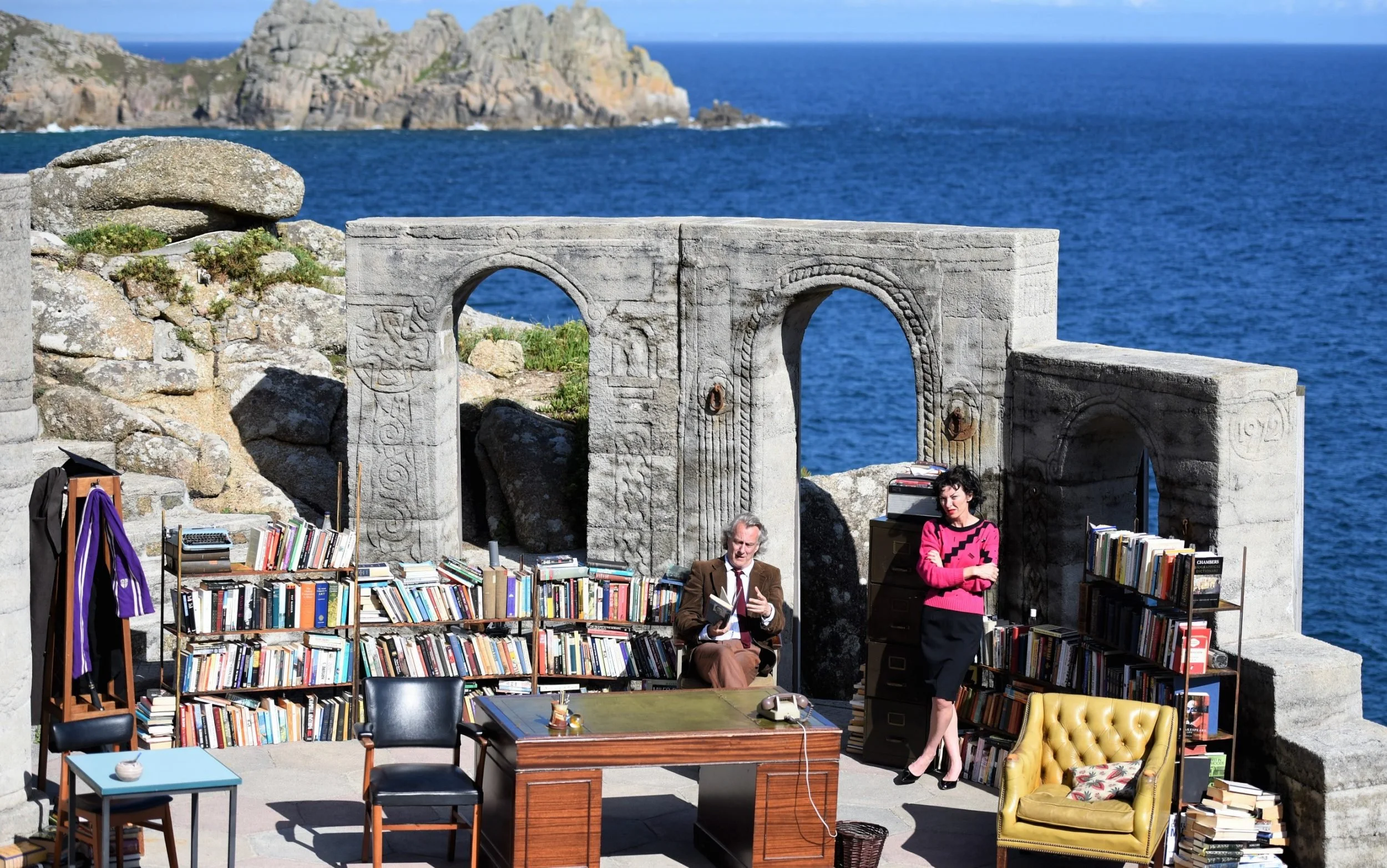
UK Tour. 2019 & 2021
Producer - David Pugh and Theatre by The Lke
Director - Max Roberts
Cast
Rita - Jessica Johnson
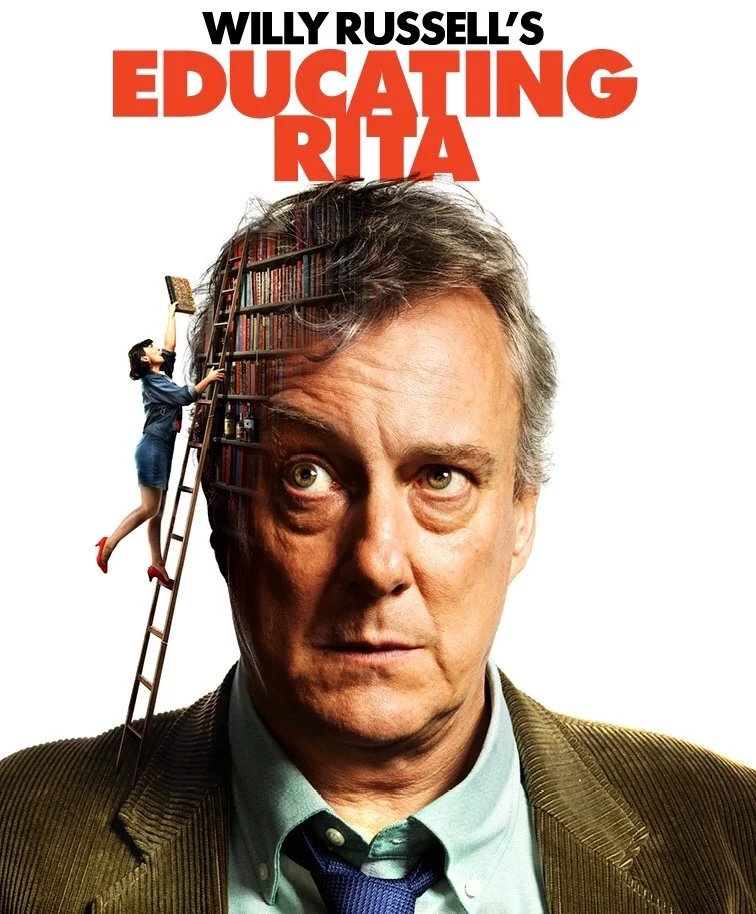
Frank - Stephen Tomkinson
Producer David Pugh and Willy first worked together in the mid Eighties when David was responsible for the touring production of Blood Brothers. In the early 2000’s the writer and producer ( along with friend and colleague Tim Firth ) again joined forces to present the song/spoken word stage show The Singing Playwrights. “Then sometime in early 2018 I got a call from David saying he wanted to present a ‘ fortieth anniversary tour ‘ of Educating Rita. My first thought was, ‘ Forty years! Where the hell did they go ? ‘ By now David was rushing on, telling me that Stephen Tompkinson and Jessica Johnson wanted to play the roles of Frank and Rita. And so my next thought was,’ how lucky am I.’ lucky and boundlessly blessed with the good fortune of having my work graced throughout the years by so many extraordinarily talented and gifted actors.”
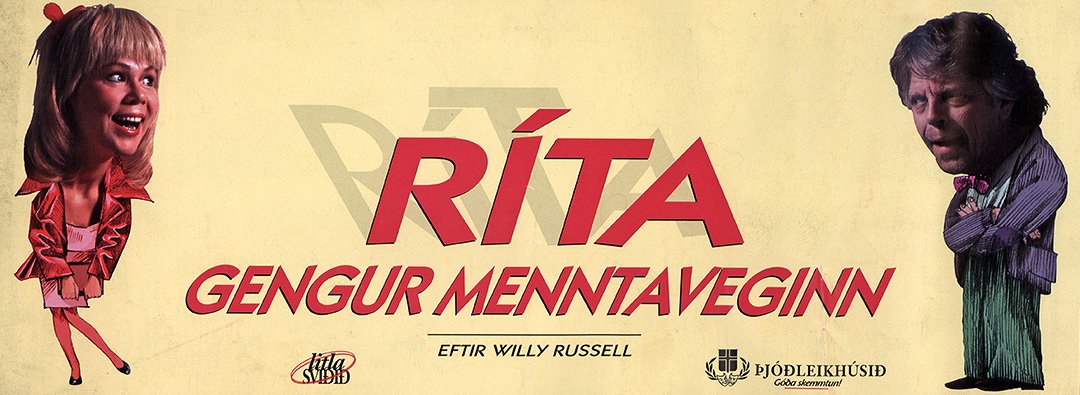
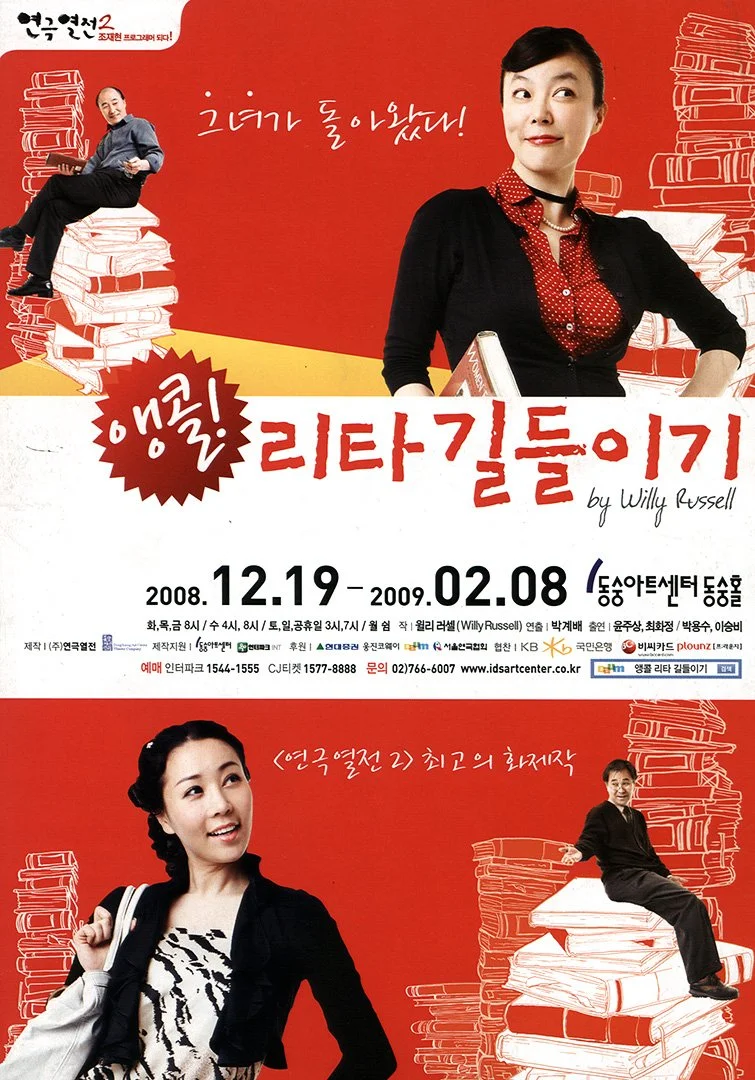
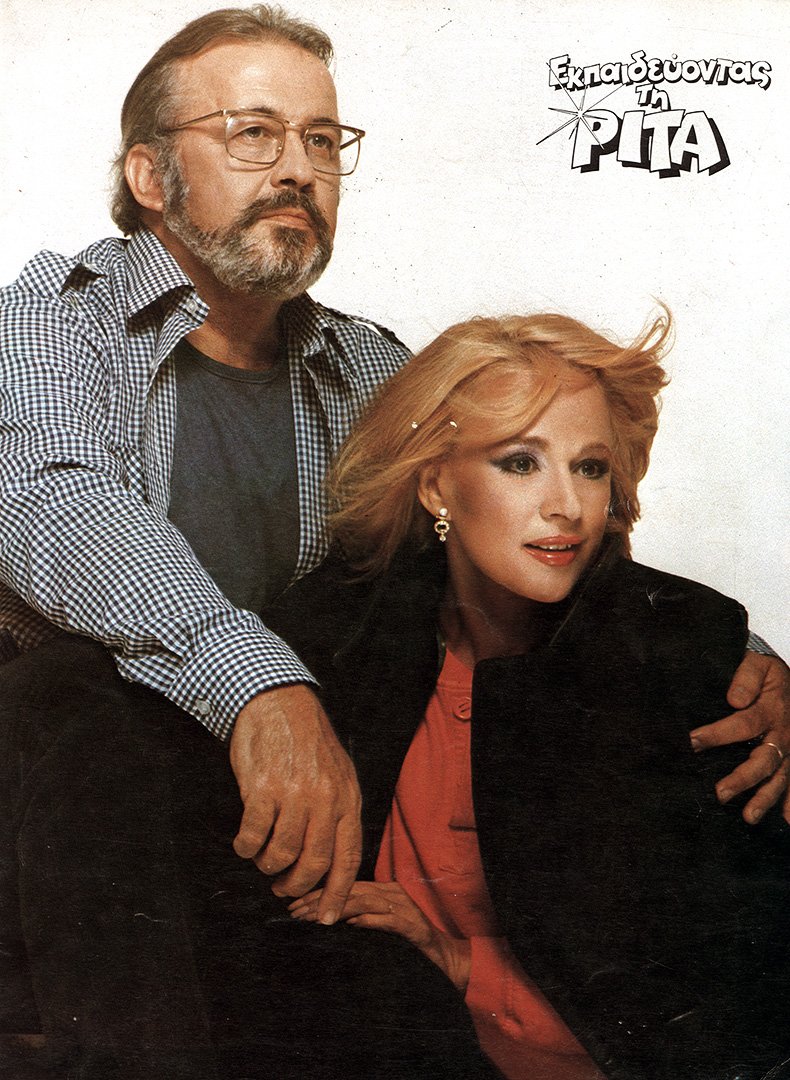
To list and credit every production of Educating Rita is beyond the scope of this website but those seeking further information relating to other productions may want to consult and explore The Willy Russell Archive, Liverpool John Moores University Special Collections and Archives.